Start counselling with a student profile, not a blank slate
AI student intake forms for study-abroad consultancies
Collect destination, course, intake, marks, budget and test status before the first call. Students answer in their own words; ConvoForm can ask a follow-up when details are unclear.
Your counsellors make the recommendations. ConvoForm helps collect the context.
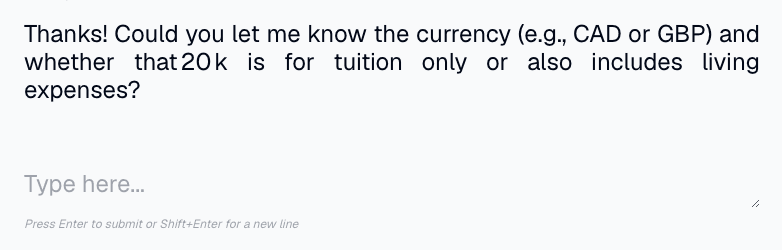
A name and phone number aren't enough to start counselling
An enquiry often arrives with a name and a phone number. Country, course, intake, marks, budget and test status still have to come out before counselling can be useful.
A standard form can ask for a currency and a test status directly. Free-text still needs a follow-up when the meaning is unclear: a budget of "20" does not say the currency or what the amount covers, and "not yet" is a status, not a score.
Keep the fields. Change how you ask for them.
You decide which details matter. ConvoForm asks for them in a conversation, and can follow up when an answer is unclear.
Define the profile you need
Describe the fields you need, including a budget with its currency and scope, marks with a grading scale, and an intake with its year. Review the generated form before you share it.
Share the form link
Publish the form and share its link from your website, social bio or enquiry replies. When an answer does not meet a field, ConvoForm can ask a follow-up before it saves the answer and moves on.
Review the answers before following up
Review the collected answers and the conversation, then decide what still needs checking. A counsellor still needs to verify the student's details and assess suitable options.
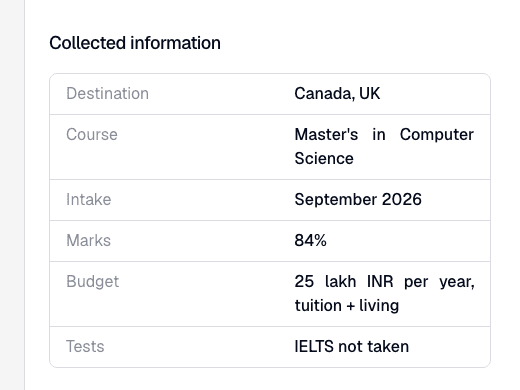
Collect the six details your first call needs
This study-abroad example uses six fields. Adjust the descriptions to match your consultancy's process.
Destination
What to ask for
Preferred country, or that the student is still exploring
Why it helps the counsellor
Establish the starting point without treating uncertainty as a bad lead
Course
What to ask for
Subject area and intended level of study
Why it helps the counsellor
Understand what the student wants to pursue
Intake
What to ask for
Preferred start month or term, with the year
Why it helps the counsellor
Understand the student's timeline
Marks
What to ask for
Latest qualification, marks or CGPA, and grading scale
Why it helps the counsellor
Prepare for an academic-profile discussion
Budget
What to ask for
Approximate amount, currency, and whether it includes living costs
Why it helps the counsellor
Start a realistic conversation about affordability
Tests
What to ask for
Relevant test, score if taken, or current preparation status
Why it helps the counsellor
Know what is already available and what needs planning
A student who hasn't chosen a country or taken IELTS may still be worth speaking to. Configure the intake to capture "not decided" and "not taken yet" honestly, rather than pushing students to invent an answer.
What you can use today, and what isn't included
Available today
- Create a conversational form and describe what each answer should contain.
- Publish a link. When an answer does not meet a field, ConvoForm can ask a follow-up.
- Review the collected answers and the conversation before you follow up.
Not included in this intake workflow today
Today, ConvoForm collects answers and lets your team review the conversation. It does not score leads, send WhatsApp summaries or book counselling appointments. Your team handles follow-up.
AI can misunderstand an answer. Accepted answers are not verified academic records, proof of funds or an admissions assessment. Review important details with the student.
Questions from consultancy owners
What should a study-abroad enquiry form collect?
Start with destination, course, intake, marks, budget and test status. Include enough detail to make the answers usable, such as the intake year, grading scale and budget currency. Collect only the additional personal information your team actually needs for follow-up.
How is this different from a standard enquiry form?
A standard form collects values in fields. ConvoForm asks for those values through a conversation and can generate a clarification when an answer doesn't meet the field requirements. You still control the information to collect; the AI generates the wording of the questions.
Is this just conditional branching?
Not in its core follow-up flow. Conditional branching selects a question or path you've set up. ConvoForm generates a question using the current field and conversation context when an answer needs clarification. It then continues through the configured fields. That doesn't mean the AI can run an unrestricted counselling conversation or make admissions decisions.
Can students answer if they haven't taken IELTS or chosen a country?
Design the relevant fields to accept that status. "Not taken yet" or "still deciding" can be useful information for a counsellor. Test the form before sharing it so the requirements don't force a score or a destination from a student who doesn't have one.
Can I use it for enquiries from Instagram or WhatsApp?
You can share the published web-form link in your social bio or enquiry replies. The student completes the conversation on the web. Sharing a link through WhatsApp is different from running the intake inside WhatsApp. ConvoForm does not send WhatsApp summaries or run a native WhatsApp bot.
Does ConvoForm automatically qualify or rank students?
It checks whether an answer satisfies a form field's requirements. That's different from deciding whether a student is ready to apply or ranking a sales lead. Your team still reviews the profile and decides what to do next.
Will it recommend universities or assess visa eligibility?
This intake collects information. It isn't a university-matching service or a visa adviser. Your counsellors remain responsible for recommendations, current entry requirements and any visa guidance.
Does it replace our CRM or follow-up process?
No. ConvoForm collects answers and lets your team review the conversation. It does not hand off to a CRM, book a counselling appointment, or send follow-up messages. Your team handles follow-up.
Give your next counselling call a better starting point
Collect the student's plans and current situation before the call. Let your counsellor spend that conversation understanding the student, rather than starting from a name and number.
Start with destination, course, intake, marks, budget and tests. Review the form, test a few unclear answers, then share it.